Quo vadis ars?
 The situation in the cultural sector has been
described and discussed in numerous interviews, corona diaries,
comments and reports in the past few weeks. Our annotated
collection
of currently 193 sources
gathers voices from different sectors and media.
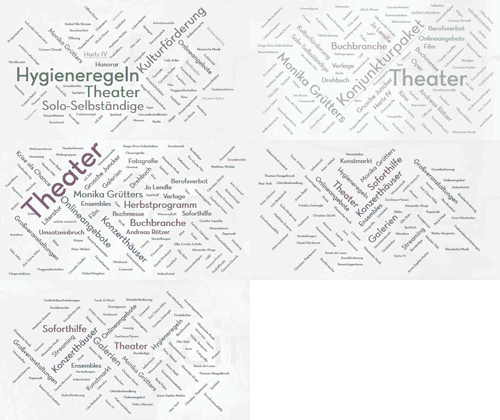
This creates a picture of the cultural landscape in crisis,
whose temporal transformation can be explored interactively
via a dedicated
tag cloud.
The situation in the cultural sector has been
described and discussed in numerous interviews, corona diaries,
comments and reports in the past few weeks. Our annotated
collection
of currently 193 sources
gathers voices from different sectors and media.
This creates a picture of the cultural landscape in crisis,
whose temporal transformation can be explored interactively
via a dedicated
tag cloud.


Kinos in Not . Betreiber fordern finanzielle Hilfen – und blicken neidisch nach Bayern
Cinemas in need . operators demand financial aid - and look enviously to Bavaria
by Tim Spark (05 Sep 2020)
Original source: Handelsblatt
The film industry is suffering from the Corona crisis. Above all, German cinema operators do not see how they can maintain their program offerings in the long term. Michael Pawlowski, co-partner of the Filmpalast Group, reports a 50 percent drop in visitors in North Rhine-Westphalia. In federal states with stricter visitor regulations - in NRW only one seat has to be vacated - the decline is even more serious. This means that cinema operations are currently being run from reserves, as the revenues are not sufficient to cover them.
This is the situation that 68 med ium-sized, family-run movie theaters have to address in an open letter to Monika Grütters. The cinema operators need financial support and a relaxation of the hygiene rules. Since the movie theaters are well ventilated and the visitors do not speak during the screening, the risk of infection is lower in the cinema than in the office, according to a study by the Hermann Rietschel Institute of the Technical University of Berlin.
But it is not only the rules of distance that make life difficult for cinema operators. Film distributors are currently holding back on film releases because the number of visitors is currently not very attractive.
Although the German Minister of State for Culture has already released funds to support cinemas, these funds are tied to conversion, modernization and equipment measures and are therefore not helping to save the cinemas in the current liquidity squeeze.
In Bavaria, there is currently an aid program in place that compensates cinema operators for every visitor they have less than last year. In the other federal states, this model is seen as an opportunity to at least cover the fixed costs of the cinemas and prevent a cinema from dying out. Read More Read Less
This is the situation that 68 med ium-sized, family-run movie theaters have to address in an open letter to Monika Grütters. The cinema operators need financial support and a relaxation of the hygiene rules. Since the movie theaters are well ventilated and the visitors do not speak during the screening, the risk of infection is lower in the cinema than in the office, according to a study by the Hermann Rietschel Institute of the Technical University of Berlin.
But it is not only the rules of distance that make life difficult for cinema operators. Film distributors are currently holding back on film releases because the number of visitors is currently not very attractive.
Although the German Minister of State for Culture has already released funds to support cinemas, these funds are tied to conversion, modernization and equipment measures and are therefore not helping to save the cinemas in the current liquidity squeeze.
In Bavaria, there is currently an aid program in place that compensates cinema operators for every visitor they have less than last year. In the other federal states, this model is seen as an opportunity to at least cover the fixed costs of the cinemas and prevent a cinema from dying out. Read More Read Less
tag Kinobetreiber Filmwirtschaft Neustart Kultur Filmproduktion Monika Grütters Hygieneregeln Performing Arts/ Cinema Bericht

Von Zombies, Würmern und Corona auf dem Land . Lola Randl über „Die Krone der Schöpfung“
About zombies, worms and Corona in the countryside . Lola Randl on the „The Pride of Creation“
by Lola Randl, Frank Meyer (28 Aug 2020)
Original source: Deutschlandfunk Kultur
Lola Randel wrote one of the first pandemic novels with her novel "The Pride of Creation". The novel is set in a village and deals with life with and in nature, as well as with how to deal with the pandemic, which breaks into the village idyll width townspeople fleeing in their vacation homes. Whether the first-person narrator is actually infected remains open. The novel consists of short, small chapters, which are listed again in a register at the end. The almost lexical chapters structure the fictional text and help the narrator to grasp the situation. The st ructure of the lexica also provides the narrator with support, however, as she gets lost in her research on the Internet. Randel thus finds a narrative picture of how many people at the beginning of the pandemic obtained information on the Internet in a patchwork of images.
The narrator is working on a zombie story, which is why the undead play an important role in the narrative. They have a metaphorical role, since they stand for the virus as the smallest zombie, the smallest undead. In the interview, the author herself is surprised that the zombie story has taken up such a large space in the novel at the end.
The motto of the novel is a poem from the baroque era. Mortality, which the baroque author Andreas Gryphius deals with, is a counter position to the repression of death in the present. In dealing with the transience of life, the author poses the question of how to explain society's reactions to the current threat in relation to the pandemic.
The interview gives the impression that Randel's narrative is controlled by emotions and experiences. Themes and motifs are imposed by the narrative and are given space in the novel. Whether the handling of the pandemic in the narrative is just as unreflected as the author would like to make us believe, the readers must probably find out for themselves. Read More Read Less
The narrator is working on a zombie story, which is why the undead play an important role in the narrative. They have a metaphorical role, since they stand for the virus as the smallest zombie, the smallest undead. In the interview, the author herself is surprised that the zombie story has taken up such a large space in the novel at the end.
The motto of the novel is a poem from the baroque era. Mortality, which the baroque author Andreas Gryphius deals with, is a counter position to the repression of death in the present. In dealing with the transience of life, the author poses the question of how to explain society's reactions to the current threat in relation to the pandemic.
The interview gives the impression that Randel's narrative is controlled by emotions and experiences. Themes and motifs are imposed by the narrative and are given space in the novel. Whether the handling of the pandemic in the narrative is just as unreflected as the author would like to make us believe, the readers must probably find out for themselves. Read More Read Less
tag Corona-Roman Zombies Gesellschaft Metapher Literature/ Text Interview

Es sieht düster aus, bilanziert die Schweizer Museumsbranche . Corona-Folgen für Museen
It looks rather gloomy, concludes the Swiss museum industry . Consequences of Corona for museums
by brik/kusv (10 Aug 2020)
Original source: Radio SRF 2 Kultur
"It's terrible what you just see and hear informally," says Tobia Bezzola, President of the Swiss Association of Museum Professionals ICOM, commenting on the situation of museums in Switzerland. There has been a 50 to 80 percent drop in visitor frequency. Site location, type of funding and the proportion of inter-regional visitors are currently determining the extent of the losses. Using the example of the Museum of Science Kulturama in Zurich, the Museo d'arte della Svizzera Italiana MASI and the Museum of Natural History St. Gallen, the article illust rates the concerns of museum directors in Switzerland. At present, they are able to cope with the operation with the help of reserves and the support of the cantons, but if the crisis lasts longer, job cuts and a reduction of the cultural program must be taken into consideration.
Read More
Read Less
tag Museen Besucherzahlen Finanzen öffentliche Finanzierung Claudia Rütsche Tobia Bezzola Toni Bürgin Visual Arts/Design Bericht
Berliner Künstler: Jetzt gehen sie für mehr Corona-Hilfe auf die Straße
Berlin artists: Now they take to the streets for more Corona help
by Florian Thalmann (08 Aug 2020)
Original source: Berliner Kurier
The artists were the first ones who were not allowed to work any more. They will be the last to return to a normal everyday life. Nevertheless, there is no support for the professional group of self-employed artists. Although an emergency aid of 5,000 € was paid out in Berlin at the beginning of the crisis, since then this professional group has only been able to apply for assistance for current business expenses. Cost of living can only be obtained through the state benefit scheme Hartz IV. With a demonstration on Sunday, August 9, 2020, the Berlin based artists ca lled attention to their situation. They are demanding an existential support that will enable them to overcome the crisis until they can return to a normal life.
Read More
Read Less
tag Künstler Hilfe Jetzt Demonstration Existenz-Geld Hartz IV All sections Bericht

Durchs Raster gefallen . Kulturschaffende in Coronakrise
Fallen through the cracks . the arts community during Corona crisis
by Sabine Seifert (29 Jul 2020)
Original source: taz
Three months after an initial conversation about her personal situation as an artist during the lockdown, Sabine Seifert meets again with a singer, a visual artist, an actor and a museum educator to talk with them about their experiences during the Corona crisis.
The working conditions for the artists are still all but optimal, as the hygiene rules for all cultural fields of work entail restrictions. Many people appreciate the social network that is provided in Germany. Emergency aid and basic security have helped them to survive the last few months financ ially. However, applications for basic security have only increased by about a quarter. Due to the bad aura of basic security called Hartz IV, many people were reluctant to apply.
Even the applications for solo self-employed persons do not take into account the living and working conditions of artists even after three months. Seifert critically observes that in many federal states the cost of living may not be regarded as operating costs, but also the fact that in the second round applications may only be made by tax or accountants is completely ignoring the reality of small and medium-sized enterprises. Although the profession of an artist is fundamentally associated with uncertainty, the general conditions have currently changed radically. No one can predict with certainty how the pandemic will develop. When again which event format will be possible.
Olaf Zimmermann, Managing Director of the German Cultural Council, points out that the working structures on the cultural market have changed in recent years. Although there are fewer artists, there are more solo self-employed people in the field of cultural education, management and technology. Cultural policy has failed to counteract the precarious structures that have emerged here. Basically, according to Olaf Zimmermann, one should think about whether the classic concept of the entrepreneur still applies to artists and cultural workers - especially since they make an important contribution to society. Read More Read Less
Even the applications for solo self-employed persons do not take into account the living and working conditions of artists even after three months. Seifert critically observes that in many federal states the cost of living may not be regarded as operating costs, but also the fact that in the second round applications may only be made by tax or accountants is completely ignoring the reality of small and medium-sized enterprises. Although the profession of an artist is fundamentally associated with uncertainty, the general conditions have currently changed radically. No one can predict with certainty how the pandemic will develop. When again which event format will be possible.
Olaf Zimmermann, Managing Director of the German Cultural Council, points out that the working structures on the cultural market have changed in recent years. Although there are fewer artists, there are more solo self-employed people in the field of cultural education, management and technology. Cultural policy has failed to counteract the precarious structures that have emerged here. Basically, according to Olaf Zimmermann, one should think about whether the classic concept of the entrepreneur still applies to artists and cultural workers - especially since they make an important contribution to society. Read More Read Less
tag Soforthilfe Grundsicherung Solidarität Verdi bbk Elisabeth Anschütz Sascha Oliver Bauer Ka Bomhardt Wilko Reinhold Olaf Zimmermann All sections Bericht

Der verzögerte Kulturinfarkt . Resilienz des Kulturbetriebs
The delayed culture infarction . Resilience of the cultural sector
by Dieter Haselbach, Pius Knüsel (27 Jul 2020)
Original source: Kulturmanagement
The cultural industry has long been a two-tier society. While the state-financed cultural institutions will come through the crisis with the help of much public funding, the many private institutions and artists will fall victim to the crisis. The public institutions are not innocent of this, as they have used the solo self-employed as an inexhaustible reserve army.
In view of the fact that even before the crisis there was a discussion about the dwindling public in cultural institutions and the loss of significance of museums, the authors are irritated by a contri bution by Tobias J. Knobloch, President of the Kulturpolitische Gesellschaft, who urged that public funding be expanded in order to avert the consequences of the crisis for the cultural industry. In this context he also speaks of resilience.
Here it should not be forgotten that the crisis is the great time for cultural associations. They are now trying to get a share of the public funding.Differently it looks with the solo independent ones, which fall by the promotion rasters of the federation and federal state governments for enterprises and come thus over the rounds only with an application for unemployment relief ALG II .
Here the authors come to the crucial point of their article: Many artists do not have a business model that would be sustainable and provides for reserves and a sensible old-age provision. Postponing crisis and old-age provision until later is not a model with a future. Even if the state is currently generous, sustainable business practices must be introduced in the cultural sector.
In their outlook, the authors assume that the large state-financed houses will survive the crisis, and that many solo self-employed and privately financed houses will give up. Cultural tourism will also start again in 2021. The only chance the stakeholders have is to create new room for maneuver. A cultural infarction can currently only be avoided if the funding instruments and organizational principles are reconsidered and digitization is promoted. Read More Read Less
In view of the fact that even before the crisis there was a discussion about the dwindling public in cultural institutions and the loss of significance of museums, the authors are irritated by a contri bution by Tobias J. Knobloch, President of the Kulturpolitische Gesellschaft, who urged that public funding be expanded in order to avert the consequences of the crisis for the cultural industry. In this context he also speaks of resilience.
Here it should not be forgotten that the crisis is the great time for cultural associations. They are now trying to get a share of the public funding.Differently it looks with the solo independent ones, which fall by the promotion rasters of the federation and federal state governments for enterprises and come thus over the rounds only with an application for unemployment relief ALG II .
Here the authors come to the crucial point of their article: Many artists do not have a business model that would be sustainable and provides for reserves and a sensible old-age provision. Postponing crisis and old-age provision until later is not a model with a future. Even if the state is currently generous, sustainable business practices must be introduced in the cultural sector.
In their outlook, the authors assume that the large state-financed houses will survive the crisis, and that many solo self-employed and privately financed houses will give up. Cultural tourism will also start again in 2021. The only chance the stakeholders have is to create new room for maneuver. A cultural infarction can currently only be avoided if the funding instruments and organizational principles are reconsidered and digitization is promoted. Read More Read Less
tag Museen Kulturförderung Soforthilfe Solo-Selbständige Hartz IV Olaf Zimmermann Tobias J. Knobloch All sections Bericht

Macht die Theater zu – und fangt von vorne an . Theater als Gesellschaftslabor
Close the theaters - and start from scratch . Theater as social laboratory
by Björn Bicker (20 Jul 2020)
Original source: BR Kultur
Björn Bicker considers the slogan of the »crisis as an opportunity«, which is often used in connection with the Corona pandemic, to be one of the last possibilities to save the German-speaking publicly financed theater landscape. His analysis of the situation is unsparing: at the theaters, which are predominantly run by despots, plays are now only performed for a parallel society. The white, well-off middle class is having its theaters financed by an increasingly diverse society.
The compulsory pause, which was heralded by the lockdown, could have been used as a pause for reflection. The standstill was a chance to reflect on the conditions of their own work. But instead of devoting themselves to the question of what a theater of tomorrow might look like, many houses fell into a digital hyper-actionism. Readings, short scenes up to entire performances were put on the net. The opportunity is not yet gone. Instead of continuing to indulge in an actionism that does not reach society, performing theater should pause for a while. This time can be used not only to find a new togetherness in the houses, but also to seek dialogue with a diverse audience at round tables. In this way, concepts for a theater of tomorrow can be developed. The utopia that Bicker creates is that of the municipal theater as a prototype of social development. Whether it really remains a utopia is up to the institutions themselves. Read More Read Less
The compulsory pause, which was heralded by the lockdown, could have been used as a pause for reflection. The standstill was a chance to reflect on the conditions of their own work. But instead of devoting themselves to the question of what a theater of tomorrow might look like, many houses fell into a digital hyper-actionism. Readings, short scenes up to entire performances were put on the net. The opportunity is not yet gone. Instead of continuing to indulge in an actionism that does not reach society, performing theater should pause for a while. This time can be used not only to find a new togetherness in the houses, but also to seek dialogue with a diverse audience at round tables. In this way, concepts for a theater of tomorrow can be developed. The utopia that Bicker creates is that of the municipal theater as a prototype of social development. Whether it really remains a utopia is up to the institutions themselves. Read More Read Less
tag Theater Denkpause Krise als Chance Performing Arts/ Cinema Zwischenruf

Nach dem Stillstand die Besinnung?
After the standstill, the recollection?
by Till Briegleb (07 Jul 2020)
Original source: Süddeutsche Zeitung
The corona-related closures mean millions in lost revenue for the major German museums in Dresden, Berlin, Hamburg, Munich or Cologne. Even the rapid reopening of the museums can do little to change this. If in one week there are as many visitors as before the lockdown on one day, the museums are already happy. People are still afraid of exhibition spaces with great appeal. Above all, the number of city travellers is still very low. However, the museum management does not appear to be alarmed so far. This is partly due to the fact that they currently have the feeling tha t they are supported by the state. In contrast to the wave of layoffs in America, at least the permanent employees can rely on government support. However, financing is not a very popular discussion topic at the moment. Instead, the realignment of the houses is being discussed. Many will make a virtue out of necessity and concentrate again more on content than on big names.
Read More
Read Less
tag Museen Finanzen Marion Ackermann Hartz IV Neuausrichtung Sammlung Visual Arts/Design Bericht
Pro: Kunst ist Kulturverständigung - und deshalb politisch . Pro und Contra Kulturreisen
Pro: Art is cultural understanding - and therefore political . The pros and cons of cultural travel
by Nicolas Freund (05 Jul 2020)
Original source: Süddeutsche Zeitung
Cultural trips are more than luxury? Historically, art has long been reserved only for the ruling classes. If one follows the thesis formulated by the writer John Berger in his essay "Ways of Seeing", the consideration of art is not only a democratic act, but also a place of confrontation with the past precisely because of the detachement of the ruling caste. The change of perspective in the present makes art at the same time an ideal place for the negotiation of social discourses. Therefore, one should not recklessly give up the privilege of participating in a rt events, just because it is a little more difficult to reach exhibition cities at the moment.
Read More
Read Less
tag Bildende Kunst Kulturtourismus Original Demokratie Austausch Visual Arts/Design Diskussion
Solidarität in der Krise . Die Online-Plattform »Artist in the Box«
Solidarity during the crisis . The online platform »Artist in the Box«
by Susanna Schürmanns (04 Jul 2020)
Original source: WDR
What would a society be without art? What would happen if all artists went on strike for a year? This is a thought at the moment that impressively demonstrates the importance of art for society and its critical potential. The situation of artists in North Rhine-Westphalia (NRW) is dramatic. Many of the freelance artists are fighting for survival. The project "Artist in the box" wants to draw attention to this precarious situation. About 60 artists, including such well-known photographers as Boris Becker, offer works online. Part of the income goes to the author, but a community contribution is also distributed among all artists. In this way the project wants to help everyone to survive the crisis unscathed.
The Corona Pandemic did not only affect the four photographers from Cologne, who initiated the project completely unprepared. The order books were full, project applications were approved when one cancellation after the other arrived at the beginning of March, and all income was wiped out overnight. Even though the state government in NRW provides support, the hurdles to obtaining it are great. Only half of the 30,000 artists in NRW received the 2,000 € in emergency aid, and many will probably have to pay back the 9,000 € for solo self-employed artists. The basic security as a means of subsistence does not include money for tools and equipment, without which the artists cannot pursue their profession. An instrument parallel to short-time work, as demanded by Heike Herold of the Kulturrat NRW, does not exist for the scene. Read More Read Less
The Corona Pandemic did not only affect the four photographers from Cologne, who initiated the project completely unprepared. The order books were full, project applications were approved when one cancellation after the other arrived at the beginning of March, and all income was wiped out overnight. Even though the state government in NRW provides support, the hurdles to obtaining it are great. Only half of the 30,000 artists in NRW received the 2,000 € in emergency aid, and many will probably have to pay back the 9,000 € for solo self-employed artists. The basic security as a means of subsistence does not include money for tools and equipment, without which the artists cannot pursue their profession. An instrument parallel to short-time work, as demanded by Heike Herold of the Kulturrat NRW, does not exist for the scene. Read More Read Less